
By: Tana von Isser, LMSW, CHT, Lead Primary Therapist
A complex trauma treatment center is a residential or specialized program designed to address Complex PTSD (C-PTSD) at its roots, going beyond standard PTSD care to help with the identity disturbance, emotional dysregulation, and relational wounding that develop after prolonged or repeated trauma. At Sabino Recovery, this work happens inside one trauma-focused residential treatment program where care is individualized and co-created with each person.
If you have spent years feeling stuck in survival mode, or you have tried therapy before and walked away feeling unchanged, what you are carrying may make sense in light of what you have been through. Complex trauma rarely responds to short-term, symptom-focused care. It needs a different kind of approach, one that addresses the nervous system, the body, the story, and the self.
This guide explains how complex trauma differs from PTSD, what its signs often look like in daily life, and what a trauma-first residential program at Sabino offers, from evidence-informed therapies like EMDR and somatic experiencing to the relational and environmental factors that help true healing take root.
- Complex PTSD develops from repeated or prolonged trauma and includes symptom clusters beyond PTSD: identity disturbance, emotional dysregulation, and relational difficulty.
- Standard, short-term PTSD treatment often falls short for C-PTSD because it focuses on single-event memory processing rather than the longer arc of stabilization, processing, and integration.
- Sabino Recovery offers one trauma-focused residential treatment program with 10 or more individual sessions each week and over 50 personalized touchpoints during a client’s stay.
- Evidence-informed therapies for complex trauma at Sabino include EMDR, somatic experiencing, neurofeedback, parts work, and equine and nature-based approaches.
- Healing complex trauma is rarely linear, but with the right environment, relationships, and support, lasting change is possible.
What Makes Complex Trauma Different From PTSD
Most people associate trauma with a single, identifiable event: a car accident, a natural disaster, a violent moment that splits life into before and after. Complex trauma is different. It is the slow accumulation of harm, often invisible from the outside, that reshapes how you experience yourself and the world.
Where PTSD is typically understood as the brain and body’s response to one overwhelming event, Complex PTSD (C-PTSD) develops in response to prolonged, repeated, or inescapable distress. It can begin in childhood, but it can also take root in adulthood through experiences like long-term domestic abuse, captivity, or repeated medical trauma. The diagnostic picture includes the familiar PTSD symptom clusters of re-experiencing, avoidance, and hyperarousal, alongside additional features: disturbances in self-organization, negative self-concept, and persistent difficulties in relationships.
For a closer look at the distinctions, you may find this overview of how complex PTSD compares with standard PTSD helpful.
How Complex Trauma Develops Over Time
Complex trauma rarely announces itself. It builds across years through repeated experiences of unsafety, unmet need, or relational rupture. A child who learned to read a parent’s mood for signs of danger, an adult who survived a long abusive relationship, a person who endured years of medical procedures with no sense of agency: these are all paths into the same territory.
What unites them is duration and inescapability. The nervous system did not have the time or conditions to return to baseline. Instead, it adapted, often in ways that helped you survive then and complicate life now.
The Nervous System in Survival Mode: Fight, Flight, Freeze, and Fawn
In ongoing trauma, the limbic system can become flooded with stress hormones, leaving the brain in a near-constant state of fight, flight, or freeze, even when no current threat is present. A fourth response, fawn, shows up as compulsive pleasing or attuning to others as a way of staying safe.
These are not character traits. They are biology. Your system learned that vigilance, withdrawal, numbing, or accommodation kept you alive. Healing is not about overriding these responses. It is about helping your nervous system learn that the danger has passed and that there are new, safer options available.
Common Origins: Neglect, Relational Trauma, and Chronic Invalidation
Complex trauma can grow from what happened and from what did not happen. Common roots include:
- Neglect or emotional unavailability from caregivers
- Chronic invalidation of feelings, needs, or experiences
- Repeated exposure to unsafe or unpredictable environments
- Long-term abuse, including emotional, physical, or sexual harm
- Relational trauma in adult partnerships, including coercive control or betrayal
Adverse childhood experiences (ACEs) often appear in the histories of people with C-PTSD, though complex trauma is not limited to early life.
Why Standard PTSD Treatment Often Falls Short for C-PTSD
Many trauma programs are designed around single-event PTSD. They focus on memory processing, exposure, or short-term skills. For complex trauma, that approach can feel destabilizing or simply miss the point. There is rarely one memory to process. There is a way of being in the world that took decades to build.
Clinically, complex trauma is often best supported through a phase-based approach: stabilization and skills first, then trauma processing, then integration. This sequence, recommended by the VA’s National Center for PTSD, gives the nervous system the foundation it needs before deeper work can hold.

Recognizing the Signs of Complex Trauma
The patterns that come with complex trauma are not flaws. They are adaptations that once made sense. Naming them can be tender work, especially if you have spent years interpreting them as personal failings.
Emotional Dysregulation and Difficulty Feeling Safe
Many people with C-PTSD describe feeling either too much or not enough. Emotions can swing quickly, or they can feel muted, distant, or absent. Calm states can feel suspicious, almost dangerous, because the body has not learned what safety feels like for long.
You may notice yourself bracing for impact in ordinary moments, scanning conversations for signs of disapproval, or feeling unable to settle even in quiet rooms.
Codependency and the Loss of Self
When your earliest lessons taught you that other people’s needs mattered more than your own, codependency can feel like the only way to relate. As Tana von Isser, LMSW, CHT and Lead Primary Therapist at Sabino, describes it, many trauma survivors carry a quiet internal message: “you matter, I don’t,” or “you matter more than me.”
This pattern is not about weakness. It is the residue of having to attune to others to stay safe. Over time, it can leave you uncertain about your own preferences, exhausted by overgiving, and resentful in ways you cannot quite name.
Dissociation, Intrusive Thoughts, and Hypervigilance
Complex trauma can also show up as dissociation: feeling foggy, detached from your body, or as if you are watching life from a distance. Intrusive thoughts and memories may surface without warning. Hypervigilance can leave you exhausted from constant scanning, with sleep that never quite restores.
For a closer look at how these patterns show up in daily life, this piece on living with complex PTSD may resonate.
How Complex Trauma Affects Identity and Relationships
One of the most painful features of C-PTSD is the way it can blur your sense of who you are. After years of adapting to survive, it can feel hard to locate a self underneath. Relationships often carry the weight of this: trust feels risky, intimacy feels exposing, and conflict can feel catastrophic.
Complex trauma also frequently co-occurs with depression, anxiety, substance use, and other patterns that developed as ways of coping. Treating any of these in isolation often misses the larger picture.
A Trauma-First Approach to Complex PTSD Treatment
Treating symptoms without addressing roots is one reason so many people cycle through programs without lasting relief. Symptoms make more sense when you understand the trauma beneath them. A trauma-first approach starts there.
At Sabino Recovery, our residential treatment program is designed to address trauma at the root while supporting the full range of mental health and addiction challenges that often travel with it.
Healing at the Root, Not Just the Surface
For many people who arrive at Sabino, the experience of being met at the root rather than at the symptom is itself new. Depression, anxiety, substance use, disordered eating, and relational patterns are not treated as separate problems on parallel tracks. They are understood as expressions of unresolved trauma and nervous system dysregulation that can begin to soften when the underlying experiences are met with care.
True Individualization: No Tracks, No Templates
There are no preset tracks at Sabino. Each client receives 10 or more one-on-one sessions per week with therapists, medical providers, dietitians, and integrative specialists, totaling over 50 personalized touchpoints across their stay. Treatment plans are co-created, reviewed daily, and adapted weekly as your needs evolve.
You are not assigned a curriculum. You help shape it, choosing from a range of therapies and approaches in collaboration with your team.
The Role of Safety, Environment, and Connection in Recovery
Safety is not an abstract idea in trauma work. It is something the body has to learn through repeated experience. That is why environment, relationships, and pacing matter as much as any modality. When the people around you are steady, the setting is calm, and the days have predictable rhythm, the nervous system begins to consider new possibilities.
How Sabino’s 140-Acre Desert Setting Supports Nervous System Healing
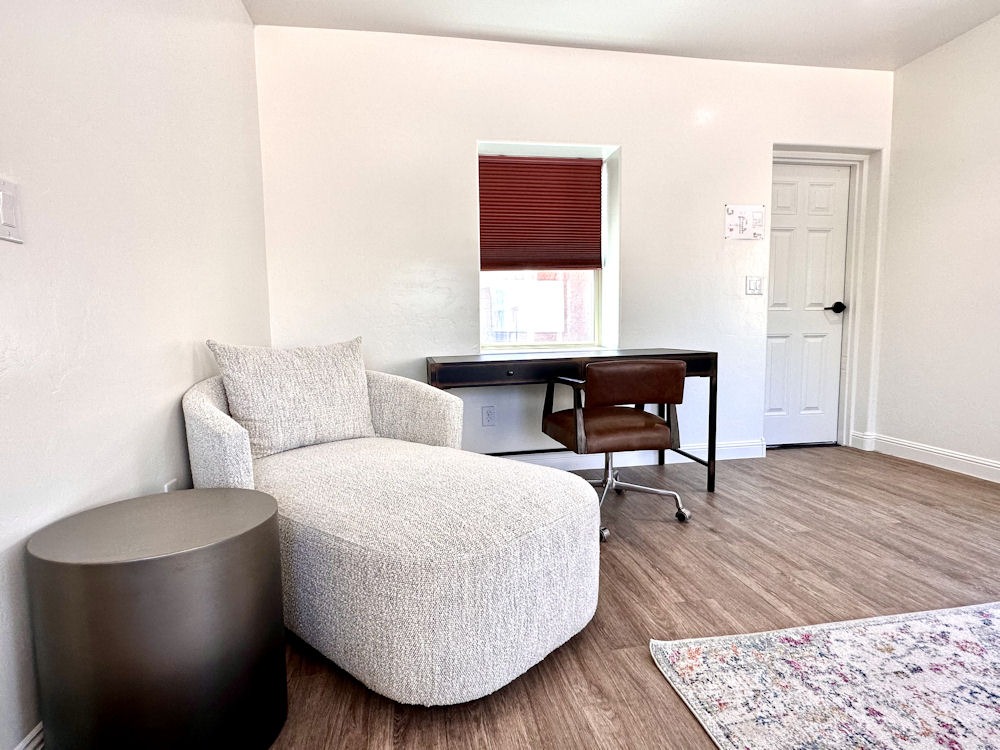
Sabino sits on 140 private acres in the Tucson desert, with quiet outdoor spaces, walking trails, and long sightlines that invite the body to settle. For people whose lives have been spent in high alert, this kind of environment is not a luxury. It is part of the clinical experience: a setting that supports stillness, reflection, and the slow work of feeling safe in your own skin.
Evidence-Informed Therapies for Complex Trauma at Sabino
Complex trauma rarely responds to a single therapy. The work asks for multiple entry points: memory, body, nervous system, relationship, and meaning. At Sabino, clients have access to a wide range of evidence-informed approaches and help choose which to weave into their plan.
EMDR Therapy for Processing Traumatic Memory
Eye Movement Desensitization and Reprocessing (EMDR) helps the brain reprocess traumatic memories so they feel less charged and intrusive over time. For complex trauma, EMDR is most effective when it is paced carefully and grounded in stabilization first.
If you want a closer look at the mechanics, this overview of how EMDR works for PTSD and trauma processing explains it in plain language.
Somatic Experiencing and Body-Based Healing
Somatic experiencing works with the body’s stored stress responses. Rather than only talking about what happened, you learn to notice sensations, complete blocked survival responses, and discharge tension your nervous system has been carrying. This helps you build a felt sense of safety that talk alone often cannot reach.
Neurofeedback and Nervous System Regulation
Neurofeedback offers real-time information about how the brain is functioning, helping it gradually move toward more regulated patterns. For people who have lived in chronic dysregulation, this can support better sleep, calmer attention, and a steadier baseline, which in turn makes deeper trauma work possible.
Equine Therapy, Nature-Based, and Experiential Approaches
Horses are uncannily attuned to human emotion. Equine therapy offers a relational mirror that does not require words, helping clients notice their own internal states and practice new ways of being present. Nature-based and experiential therapies extend this work outdoors, where the desert itself becomes part of the healing relationship.
Parts work, drawn from Internal Family Systems and related models, helps clients understand the protective and wounded parts of themselves with compassion rather than judgment. For those navigating co-occurring substance use, integrated dual diagnosis care is woven into the same individualized plan.
Reclaiming Identity and Breaking Codependent Patterns
Many people arrive in treatment quietly carrying a question they have never said aloud: who am I outside of my trauma? Years of adapting to survive can leave an identity built around pleasing others, staying small, or anticipating harm.
From Survival Mode to Self-Directed Living
As Tana von Isser explains, “Healing means rediscovering your own voice, learning to interpret emotions as information, and creating an identity based on choice rather than conditioning.” That shift is gradual, but it is real. It begins with noticing what you actually feel, want, and prefer, often for the first time in years.
Shifting from “What’s Wrong With Me?” to Compassionate Curiosity
A quiet but powerful change happens when the internal question moves from “what’s wrong with me?” to “what’s bringing this up in me?” The critical mind becomes a cue for curiosity rather than self-attack. Over time, this is the soil in which self-worth grows back.
Parts Work, Cognitive Reframing, and Reclaiming Your Voice
Through parts work and cognitive reframing, clients learn to recognize the strategies that once kept them safe, thank those strategies, and choose new responses when the old ones no longer serve. Reclaiming your voice is not a single moment. It is a thousand small ones.
Building Healthy Interdependency in Relationships
Sabino’s relational work helps clients move from “you matter, I don’t” toward “we both matter,” a foundation for healthy interdependency. Setting limits stops feeling like betrayal. Receiving care stops feeling like danger. Relationships become places of mutual presence rather than performance.
What Residential Treatment for Complex Trauma Looks Like at Sabino
Choosing residential care is a significant decision, and clarity helps. Residential treatment is often the right level of care when symptoms have not responded to outpatient work, when daily functioning is disrupted, when co-occurring substance use or mental health concerns complicate the picture, or when the safety and time of an immersive setting are needed for deeper healing.
Wondering whether residential care is the right next step for you or someone you love?
A conversation can bring more clarity than another night of weighing it alone. When you are ready, you are warmly invited to reach out to our admissions team to talk through your situation.
10 or More Individual Sessions Per Week Across Disciplines
Each week, clients receive 10 or more individual sessions with therapists, psychiatric providers, dietitians, and integrative specialists. This is not group programming with brief check-ins. It is sustained, one-on-one attention from multiple disciplines working together.
Over 50 Personalized Touchpoints Throughout Your Stay
Across a typical stay, this adds up to more than 50 individualized clinical touchpoints. The depth of relationship that builds across those hours is part of what makes the work hold.
Daily Plan Reviews and Weekly Adaptations
Your treatment plan is reviewed daily and adapted weekly. If a modality is not the right fit, it can change. If something is opening up, your team can lean into it. Care responds to who you actually are, not who a template assumed you would be.
Family Program and Continuing Care Beyond Residential Treatment
Because complex trauma is so often relational, healing is too. Sabino’s family program supports loved ones in their own understanding and healing, and continuing care extends the work after discharge through alumni support and ongoing connection. The residential stay is a strong foundation, not a finish line.

Healing Is a Journey, Not a Destination
Healing from complex trauma is rarely linear. There are seasons of breakthrough and seasons of slow ground gained. Simply arriving at treatment, after everything you have carried, is already an act of real courage.
Why Awareness Plus Compassion Is the First Step
As Tana von Isser offers, “You didn’t develop these patterns overnight, and you won’t undo them overnight either. Awareness plus compassion is the first step.” Self-knowledge without self-kindness can become another form of harm. The two have to travel together.
The Power of Witnessing Others Further Along the Path
One quiet gift of residential care is community. “Clients get to witness others who are further along in the journey,” von Isser shares. “Seeing proof that healing is possible helps them hold onto hope, even when they can’t fully believe it for themselves yet.”
Letting Others Hold Hope Until You Can Hold It Yourself
If hope feels far away right now, you do not need to manufacture it. “Find people who inspire hope,” von Isser encourages. “Let practitioners hold hope for you until you can hold it for yourself.” That is part of what a trauma-informed team is for.
Frequently Asked Questions
PTSD typically develops from a single traumatic event and includes symptoms of re-experiencing, avoidance, and hyperarousal. Complex PTSD develops from prolonged or repeated trauma and includes additional symptom clusters: disturbances in self-organization, negative self-concept, and persistent difficulties in relationships. In lived experience, C-PTSD often shows up as identity confusion, emotional dysregulation, and relational patterns that can be misread as personality issues but are actually adaptations to long-term trauma.
Yes, complex PTSD often responds well to residential treatment because it offers the time, safety, and clinical intensity that deeper trauma work usually requires. A residential setting allows for stabilization, trauma processing, and integration to happen within a consistent therapeutic environment. At Sabino Recovery, complex trauma is treated within one trauma-focused residential program that is individualized to each person’s history, symptoms, and goals.
Healing from complex trauma is rarely linear, and timelines vary widely from person to person. Residential treatment provides a foundational period of intensive care, often several weeks, followed by continuing care and ongoing support. Lasting change usually unfolds over months and years, supported by the right relationships, environment, and clinical follow-through after discharge.
EMDR can be a helpful part of complex PTSD treatment when it is paced carefully and grounded in stabilization first. For complex trauma, EMDR is most effective when it is integrated with body-based, relational, and nervous-system-focused work rather than used as a standalone intervention. At Sabino, EMDR is offered alongside somatic experiencing, neurofeedback, parts work, and other approaches so the pace can match each client’s readiness.
A trauma-first approach means treatment is organized around the unresolved trauma that often drives symptoms like depression, anxiety, substance use, and relational struggle, rather than treating those symptoms in isolation. Instead of asking only what is wrong, it asks what happened and how the nervous system adapted. At Sabino Recovery, this philosophy shapes every part of care: assessment, therapy choice, pacing, environment, and the relationships that support healing.
Sabino Recovery’s admissions team can help you understand the options available for your specific situation, including any insurance benefits and other payment considerations. Because each person’s circumstances are different, the most accurate information comes from a direct conversation. You are welcome to reach out to admissions to discuss what care at Sabino could look like for you.
When You Are Ready, We Are Here
If you have read this far, something in you is already moving toward healing. You do not have to have all the answers, or feel certain, to start a conversation. When the timing feels right, you are warmly invited to connect with our admissions team to ask questions, share what you are carrying, and learn whether Sabino might be a good fit. There is no pressure, only people ready to listen.